“The station is Badaling sir, Ba-Da-Ling”. My hotel receptionist was trying hard to inject in my memories this little keyword. It was a late November evening with the temperature around a pleasant lower 20 degrees Celsius. Soon after this conversation I took a walk along the street to explore the area next to the Forbidden City. There were street dwellers selling food and drinks and all these stalls were invariably crowded with young students. I tried to converse with some and was surprised to learn that quite a few of them understand and speak English. They gave me copious information on the eateries that were good but inexpensive. I only wish I had a whole month to explore all of them. After walking a few yards I found an elderly woman selling dumplings. I was offered six of them on a plate for RMB 4. They were delicious! Here is a funny thing I observed. Chinese dwellers use an electronic calculator to show the price. All you need to do is to point at the item and they will key-in the price to show you digitally!
Some parts of Beijing reminded me of posh European cities and
some did the opposite. In one of the lanes I found people living on the
pavements – the way they do in the city of Kolkata.
November 26, 2012 - 5:00 AM
November 26, 2012 - 5:00 AM
In the wee hours of the following morning, the receptionist insisted
on getting me a car for the whole day. I however decided to stick to the plan
and walk out on my way to the train station which I thought would be very close. The terminal that hosts five pairs of trains to Badaling is called Xizhimen. It is also called as Beijing North if the websites are to be believed.
After walking a few blocks I figured that the station is much farther than what google map showed. Also, the GPS points to a location that is definitely not correct on the map. Here my whole universe collapsed as I realized that I need help but not sure from whom since nobody was to be seen on the street. Dimmed street lights and staggering windchill of the early morning made me feel quite uncomfortable in a deserted street of the most populated nation of the world. Suddenly, like a savior on a white horse turned up a taxi cab. Its young driver was able to understand that I was planning to go to a train station. However, I could not pronounce "Xizhimen" well enough for him to decipher. He finally connected me on phone to his mother who seemed to recognize my need. She gave a patient hearing for twenty seconds and suddenly yelled “Michael...”. I handed the cell phone back to the cabbie and in no time I was in front of the station building.
After walking a few blocks I figured that the station is much farther than what google map showed. Also, the GPS points to a location that is definitely not correct on the map. Here my whole universe collapsed as I realized that I need help but not sure from whom since nobody was to be seen on the street. Dimmed street lights and staggering windchill of the early morning made me feel quite uncomfortable in a deserted street of the most populated nation of the world. Suddenly, like a savior on a white horse turned up a taxi cab. Its young driver was able to understand that I was planning to go to a train station. However, I could not pronounce "Xizhimen" well enough for him to decipher. He finally connected me on phone to his mother who seemed to recognize my need. She gave a patient hearing for twenty seconds and suddenly yelled “Michael...”. I handed the cell phone back to the cabbie and in no time I was in front of the station building.
As I walked past the taxi stand and parking lot I found
nobody in and around the station barring a few security personnel. I found a
lane where “Badaling” was written. When I asked the cop standing next to it as
where tickets can be purchased, he directed me to the main ticket counter. My internet research failed again, as I was expecting a special ticket counter for Badaling train. Here I had to cross a split rubber
curtain of "UUUUU" shape that I only saw in airport baggage carousels before. The elderly lady sitting
behind the ticket window smiled a lot at me and on my repeated request to
secure a ticket to “Ba-Da-Ling”, finally handed me one for RMB 6. I paid by
cash and thanked her for the favor.. "xie xie ah"! Flaunting this little achievement, I walked into the main
lobby of the station. The lobby was kept in darkness, only to be illuminated by
a large destination board and an LCD screen. This LCD screen was playing what looked like TV ads.
[Note: I almost felt like a "De-Ja-Vu" when an old memory struck me. There was a time when I would regularly travel from Howrah (Kolkata) to Bangalore in India. For the lack of a direct train, my usual treat was to catch the famous Coromandal Express from Howrah to Chennai. Before I could get on board the overnighter Chennai Bangalore Mail, I used to sit in the waiting lobby of Chennai Central station, trying hard to finish a novel while a very similar looking LCD screen would scream with all sorts of advertisements of local women's saree and cosmetics brands. They were all played in Tamil language which I knew not a single word of. I smiled at myself - this was real muddling of memories]
It was not hard to find the mention of my train S201 on the destination board. It was to leave from Gate No. 1 at 6:12 AM. I looked around and found nobody else who I could call a co-passenger and strike a conversation with. While the large LCD screen kept on playing advertisements, I took a stride in the otherwise ghostly lobby of the waiting hall.
[Note: I almost felt like a "De-Ja-Vu" when an old memory struck me. There was a time when I would regularly travel from Howrah (Kolkata) to Bangalore in India. For the lack of a direct train, my usual treat was to catch the famous Coromandal Express from Howrah to Chennai. Before I could get on board the overnighter Chennai Bangalore Mail, I used to sit in the waiting lobby of Chennai Central station, trying hard to finish a novel while a very similar looking LCD screen would scream with all sorts of advertisements of local women's saree and cosmetics brands. They were all played in Tamil language which I knew not a single word of. I smiled at myself - this was real muddling of memories]
It was not hard to find the mention of my train S201 on the destination board. It was to leave from Gate No. 1 at 6:12 AM. I looked around and found nobody else who I could call a co-passenger and strike a conversation with. While the large LCD screen kept on playing advertisements, I took a stride in the otherwise ghostly lobby of the waiting hall.
Picture: Waiting hall of Beijing Xizhimen station at 5:30 AM. On the left the Badaling train's departure time from Gate No. 1 can be seen.

Picture: Approach way to the platform right after passing the gate
 Next to our platform arrived an overnight express 2560 from Chifeng of Northeast China. It had a DF4D class diesel locomotive and sleeper coaches tugged behind.
Picture: The overnight express train pulling in next to the sleek looking Badaling train (white) that was ready to depart:

The bleary eyed passengers alighted with heavy baggages from the overnight train. I walked a bit longer and found our train, as can be seen parked in the next track. It definitely appeared quite impressive by looks. It had a sharp driving cab with a humming diesel engine right behind. I realized that it was technically a DMU (Diesel Multiple Unit), disguised as a high speed train. Interestingly, Xizhimen station is not electrified. All trains operating from this terminal must be diesel powered.
Picture: Badaling DMU at Beijing Xizhimen station:

It took me a few more seconds to board the train and find a seat of my choice in a carriage that was relatively empty. Passengers could be found in ones and twos here and there. A majority of them were playing with their smartphones. The interior display, air conditioning and comfort features looked flattering for a RMB 6 ticket.
Picture: Interiors of Badaling train S201:

The train started a couple of minutes behind schedule and
slowly maneuvered through the criss crossing of tracks. I realized that I did
not have breakfast and due to the jet lag I did not even feel hungry at all.
Finally, I ventured through the vestibule corridors of the train in search of food. The next one
was a refreshment car. It had large windows and tall tables next to which passengers can stand and eat. This car looked impressive as the view was better through the larger windows. The pantry keeper was loudly talking to
a staff. Seeing me approaching him, he stopped for a moment. I directed him to
a ready to eat cup-o-noodle (that was the only edible item that I could recognize on the rack). He carefully poured warm water in it, sealed the
cover and showed me 2 on his calculator. I paid him RMB 2 and walked back to my
seat with my breakfast!
Picture: The refreshment car with large widows. The seller's counter can be seen at the other end of the coach

I have to say that there were a lot more options out
there, but all of them looked so unfamiliar that I had to give in to the old
faithful cup-o-noodle which was probably void of any nutritional values. Anyway, train seemed to have picked up speed with the sky brightening up every second, eagerly waiting for the first ray of sun. S201 ran as an express train through the suburban
landscape that was dotted with high rise apartments, agricultural fields, smaller factories and little train
depots. S201 made its first stop at a station that looked like a junction to me.
Here a lot of construction workers boarded the train. They very loudly started conversing with each other.
Picture: View of a wayside station (taken on return journey since the onward journey in this part of Beijing's suburbs was passed before dawn broke):

Picture: A siding featuring some colorful coaches
 Picture: View of the mountains from train:

Picture: Another view of the mountains from train

In another few minutes I could spot the Great Wall of China - or a section of it next to the railway line. Wow! This was massive!!
Picture: The Great Wall as seen from the train
Picture: View of a wayside station (taken on return journey since the onward journey in this part of Beijing's suburbs was passed before dawn broke):
Picture: A siding featuring some colorful coaches
Picture: Another view of the mountains from train
In another few minutes I could spot the Great Wall of China - or a section of it next to the railway line. Wow! This was massive!!
Picture: The Great Wall as seen from the train

Picture: The Great Chinese Wall from a distance:
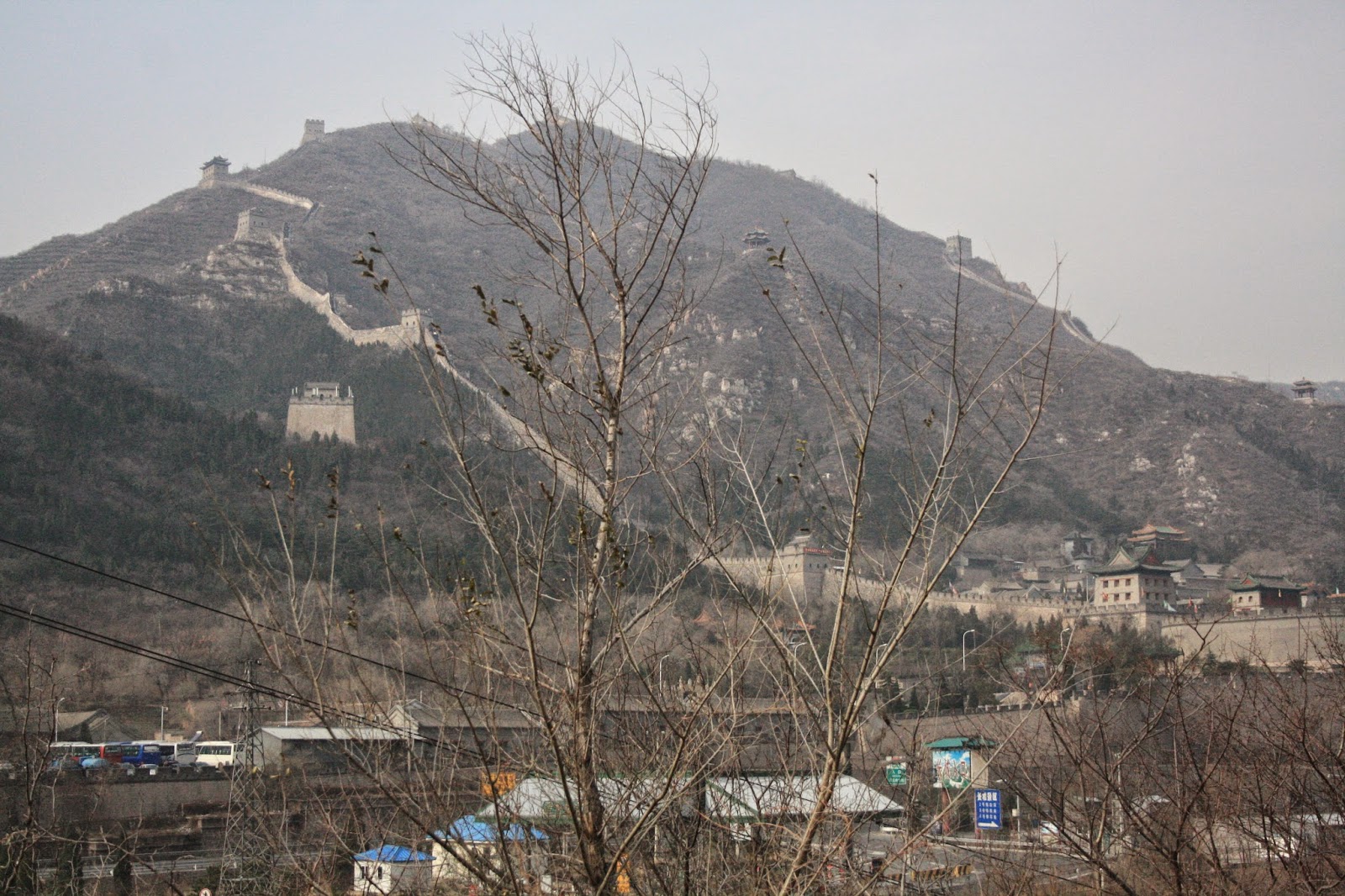
I was thrilled witnessing the only man made structure that can be seen from the moon. As the train now entered mountain zone of Yanqing county, it started encountering tight curves and hence had to reduce speed before finally coming to a screeching halt at Changping. After a stopover for five minutes, the train started running in the reverse direction to enter Badaling line. Right here we crossed the snow line. The outside landscape portrayed a combination of grey mountains and forests carpeted by white snow deposited on the ground.
Picture: Crossing Badaling Expressway through an overpass

Picture: Badaling station

Picture: Exit board hanging from station building. The snow covered tracks move downhill towards Beijing. This is the pair of tracks that took us to Badaling:

Picture: Interior of the station that had a few people dozing off

Bidding a goodbye to S201, I started following the group of people along the street next to the station to The Great Wall. Within a few steps, the statue of a Ming warrior and a tourist destination board were seen. Here I knew that I was walking in the right direction.
Picture: On way from station to Badaling tourism village

Picture: Tourist destination finder that had English subtitles

On walking another half a kilometer, I crossed the bus station and landed in Badaling tourist-village. It had a number of gift shops, hotels and tea/refreshment stalls. Only a few were open. I stopped by one tea stall. The tea was served in a tiny porcelain cup that could be refilled multiple times.
After this point, the street steeply climbed on to the
mountains and crossed the Great Wall through a gate like structure, behind
which the main entrance was seen.
Picture: A little walk through the streets of Badaling tourist village

Picture: Looking down from the gate

Picture: this place looked like a famous tea stall:

Picture: the gate like structure between tourist village and entry point to the Great Wall

There were some more gift shops next to the ticket counter that offered the same items with exorbitantly higher prices than the train station's tiny gift shop. Surprisingly, the queue was quite long for entering the great wall. After getting the ticket I headed in to this incredible structure that was primarily built by Quin, Han and Ming Dynasties. For someone who saw it could witness its enormity and strategic importance of bygone era. It was a very cold morning, but that did not deter the chirping birds to welcome the feeble morning sun. The whole day I spent at The Great Wall was one of the most memorable days of my life. However, the archaeological aspects of it would be another story meant to be told another day.
Picture: View from gate entrance:

Picture: Author on The Great Wall

Picture: A little walk through the streets of Badaling tourist village
Picture: this place looked like a famous tea stall:
Picture: the gate like structure between tourist village and entry point to the Great Wall
There were some more gift shops next to the ticket counter that offered the same items with exorbitantly higher prices than the train station's tiny gift shop. Surprisingly, the queue was quite long for entering the great wall. After getting the ticket I headed in to this incredible structure that was primarily built by Quin, Han and Ming Dynasties. For someone who saw it could witness its enormity and strategic importance of bygone era. It was a very cold morning, but that did not deter the chirping birds to welcome the feeble morning sun. The whole day I spent at The Great Wall was one of the most memorable days of my life. However, the archaeological aspects of it would be another story meant to be told another day.
Picture: View from gate entrance:
Picture: Author on The Great Wall


